





Introduction to GLP-3RT (Research Use Only)
GLP-3RT is an experimental peptide analog designed to explore receptor activity within the glucagon-like peptide (GLP) family. Members of this peptide family—including GLP-1 and GLP-2—have been widely studied for their roles in glucose regulation, gastrointestinal physiology, and metabolic signaling.¹ Research into incretin hormones has significantly advanced understanding of how peptide hormones regulate nutrient metabolism and endocrine communication between the gut and other organ systems.²
GLP-3RT is a synthetic construct developed for receptor-binding research, metabolic signaling studies, and structure–function analysis. Unlike clinically investigated incretin analogs, GLP-3RT is intended strictly as a laboratory research tool.
Current research involving GLP-family peptides focuses on understanding how structural modifications influence receptor specificity, intracellular signaling pathways, and pharmacokinetic behavior.1-3 GLP-3RT is used experimentally to explore these types of structure-activity relationships.
Molecular Structure
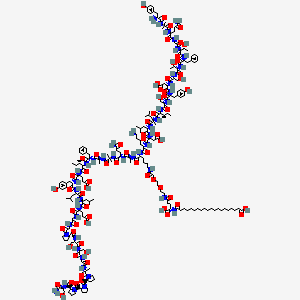
Sequence:
YA1QGTFTSDYSIL2LDKK4AQA1AFIEYLLEGGPGSSGAPPPS3
Molecular Formula:
C₂₂₁H₃₄₂N₄₆O₆₈
Molecular Weight:
4731 g/mol
PubChem SID:
171390338
CAS Number:
2381089-83-2
Synonyms:
GLP-3RT; LY-3437943; NOP2Y096GV; triple receptor agonist (GIP / GLP-1 / glucagon receptor agonist)
Source: PubChem
Note: The molecular information above corresponds to the broader class of tri-receptor incretin agonists designed to interact with the GIP, GLP-1, and glucagon receptors. GLP-3RT is referenced here as a comparative experimental analog for receptor research and is not intended for human use.
Research Highlights
1. Receptor Binding and Pharmacology
GLP-3RT is being evaluated in cell-based receptor assays to characterize its affinity and selectivity across incretin receptor systems. Studies of GLP receptor signaling have demonstrated that peptide ligands can produce distinct receptor conformations and downstream intracellular signaling responses.³
2. Metabolic Signaling Pathways
GLP-1 and related incretin hormones are known to influence glucose homeostasis, insulin secretion, and energy metabolism.1,2 Experimental peptide analogs such as GLP-3RT may help researchers investigate additional signaling pathways related to energy balance, lipid metabolism, and nutrient sensing.
3. Structural Biology and Stability
Synthetic GLP-family analogs frequently incorporate amino-acid substitutions and structural modifications to improve resistance to enzymatic degradation and extend peptide stability.¹ These structural features are useful for molecular-dynamics modeling, receptor docking studies, and peptide folding analysis.
4. Potential Physiological Insights
Although GLP-3RT itself is not intended for clinical investigation, research involving GLP-family peptides has contributed to broader understanding of:
- Gut–brain signaling pathways
- Satiety regulation and metabolic signaling
- Hepatic lipid metabolism
- Peptide hormone receptor selectivity and signaling mechanisms1-4
5. Safety and Research Context
No clinical or animal safety data currently exist for GLP-3RT specifically. Investigations of GLP-family peptides are typically conducted within controlled laboratory environments. All observations related to GLP-3RT remain experimental and exploratory.
References
- Drucker DJ. The biology of incretin hormones. Cell Metab. 2006;3(3):153-165. doi:10.1016/j.cmet.2006.01.004
- Nauck MA, Meier JJ. Incretin hormones: their role in health and disease. Diabetes Obes Metab. 2018;20(suppl 1):5-21. doi:10.1111/dom.13129
- Yusta B, Baggio LL, Koehler JA, Holland D, Cao X, Pinnell LJ, Johnson-Henry KC, Yeung W, Surette MG, Bang KW, Drucker DJ. GLP-1 receptor signaling improves β-cell function and survival. Endocrinology. 2006;147(8):3646-3655. doi:10.1210/en.2006-0250
- Drucker DJ. Mechanisms of action and therapeutic application of glucagon-like peptide-1. Cell Metab. 2018;27(4):740-756. doi:10.1016/j.cmet.2018.03.001