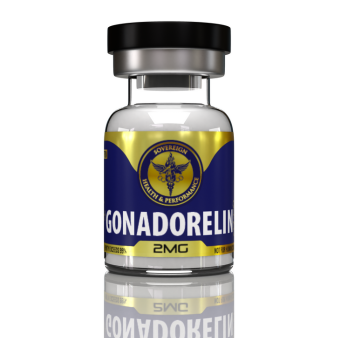
Gonadorelin is the synthetic form of the natural hormone called Gonadotropin-Releasing Hormone (GnRH) — the body’s master regulator of the reproductive and hormonal system known as the Hypothalamic-Pituitary-Gonadal (HPG) axis.
This small peptide (a chain of ten amino acids, also called a decapeptide) is released by the hypothalamus, a brain region that coordinates many automatic processes, including hormone release.
When Gonadorelin enters the bloodstream, it travels a very short distance to the anterior pituitary gland, where it binds to GnRH receptors on specialized cells. This binding triggers the pulsatile (wave-like) release of two key hormones:
The unique feature of Gonadorelin is that its effects depend entirely on how it’s administered:
Because of this dual behavior, Gonadorelin and its analogues are used extensively in hormone research, infertility treatments, and oncology to manipulate hormone levels safely and predictably.
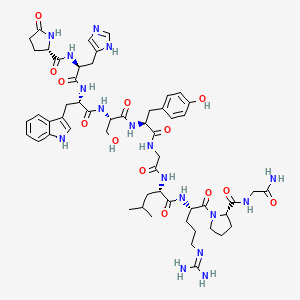
Sequence: Pyr-His-Trp-Ser-Tyr-Gly-Leu-Arg-Pro-Gly
Molecular Formula: C55H75N17O13
Molecular Weight: 1182.311 g/mol
PubChem CID: 638793
CAS Number: 9034-40-6
Source: PubChem
Gonadorelin is a cornerstone molecule in research on the HPG axis, the system that controls reproductive hormone production.
By triggering pulsatile release of LH and FSH, it helps regulate sex steroid hormones like testosterone and estradiol.
Reference:
Gonadorelin has been widely used in both men and women to study how the brain controls fertility. In women, it’s used to induce ovulation when the hypothalamus fails to release GnRH naturally (a condition called hypothalamic amenorrhea). In men, it supports sperm production by stimulating FSH and LH release.
Reference:
One of Gonadorelin’s earliest and most reliable uses is the GnRH stimulation test, used to evaluate pituitary gland health. After administration, doctors measure the resulting surge in LH and FSH. The size and timing of this surge reveal whether the pituitary is functioning normally.
Reference:
In individuals with hypogonadotropic hypogonadism (HH) — a condition where the hypothalamus or pituitary fails to produce enough GnRH or LH/FSH — Gonadorelin is used to restore natural hormone signaling through rhythmic, pulsatile infusion. This treatment can restore fertility in both men and women.
Reference:
When men use external testosterone, the body’s natural LH and FSH production often shuts down, suppressing sperm production. Research explores Gonadorelin as a way to preserve fertility during TRT by mimicking the natural GnRH pulse that keeps the testes active.
Reference:
Long-acting GnRH agonists (derivatives of Gonadorelin) are used in prostate cancer treatment to suppress testosterone production.
While short-term pulsatile GnRH increases hormone levels, continuous exposure causes the pituitary to desensitize and shut down LH/FSH release — effectively lowering testosterone to castrate levels, which slows tumor growth.
Reference:
In premenopausal women undergoing chemotherapy, GnRH analogues (like continuous Gonadorelin) can temporarily suppress ovarian function. This protects the ovaries from damage, helping preserve fertility after treatment.
Reference:
Gonadorelin and its analogues are critical tools in IVF and ART protocols.
By precisely timing GnRH agonists and antagonists, researchers can control LH surges, prevent premature ovulation, and improve synchronization for egg retrieval and implantation success.
Reference:
Continuous use of Gonadorelin analogues suppresses estrogen production, helping treat endometriosis and other estrogen-driven conditions. By lowering estrogen levels, it reduces the growth of misplaced endometrial tissue, easing pain and inflammation.
Reference:
Gonadorelin is used to both stimulate delayed puberty (when administered in pulses) and suppress premature puberty (when given continuously). Its role in regulating LH and FSH release makes it vital for understanding developmental hormone control.
Reference:
| CAS | 12079884 |
|---|---|
| MG | 10, 2 |
| Brand | Sovereign Health and Performance |